

01
Jan 2016
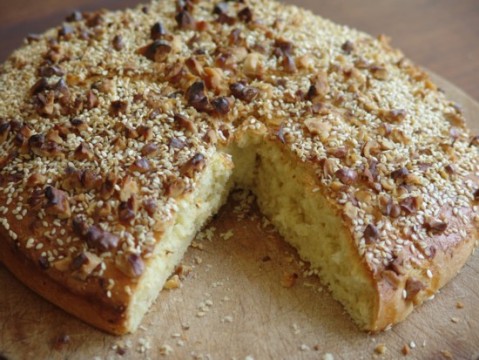
On the feast of St. Basil (January 1) it is traditional to bake and enjoy Vasilopita (pronounced “va-se-LO-pee-ta”). This special ‘pita’ (which can mean a loaf of bread, a cake, or even a pie!) is baked in honor of our Holy Father Basil the Great, archbishop of Caesarea in Cappadocia — hence its name “VasilOpita” meaning “St Basil’s Bread.” This tradition is observed in both parish churches and in the homes of the faithful. What is the meaning of this tradition and how did it begin? As the story goes, one year, during......
Read More
13
Dec 2014
by Metropolitan ANTHIMOS of Alexandroupois Here is a teaser; follow the link to continue reading. It is usually said that the custom of the Christmas tree is foreign and western. But a manuscript of the British Museum (Add. 17265 of the 13th cent.) informs us that in 512 the Emperoro Anastasios I built a church at the Monastery of Saint Gabriel in Tur Abdin in northern Syria, and among other dedications he offered: “… two large brass trees which stood on both side of the Beautiful Gate of the sanctuary. On the leaves......
Read More
17
Apr 2014
It is traditional to bring a Pascha Basket to the Paschal Services of Holy Saturday night (our service starts at 11:00pm this year, 2014). The baskets are set on or near the solea (raised platform in front of iconostasis) and are blessed at the end of the Paschal Divine Liturgy. The baskets may be put together either in a simple manner, including basic items that symbolize the transition from fasting to feasting (eggs, sausages, cheeses, etc.); they may also be put together in a more complex manner, including specific traditional items, each......
Read More
09
Feb 2014
In this two part series, recorded as part of an adult education class at St. Ignatius Antiochian Orthodox Church in Franklin, TN, Deacon Michael Hyatt helps us understand the basic motivations for the practice of fasting in the Orthodox Church. These lectures are part of the podcast series At the Intersection of East and West from Ancient Faith Radio....
Read More
07
Dec 2013
At this time of year, Christians often ask how we can better remember the “reason for the season”, and Orthodox Christians additionally ask how we can be authentically Orthodox in our seasonal remembrances. We accomplish this by being attentive to Advent (the Nativity Fast) as a distinct time of preparation for the wonderful feast of Christmas (the Nativity of Christ), then consciously celebrating both the feast itself and the ongoing festal season in the days after Christmas. … But what of the Christmas Tree? Well, our family puts ours up on St. Nicholas Day (Dec. 6). We leave......
Read More
10
May 2013
by Metropolitan Seraphim (Chicagov) the New Martyr (+1937) We are forgiven, we are saved, we are redeemed. Christ is Risen! These words say everything: they are the foundation of our faith, hope, and love; of our Christian life; of all our wisdom and enlightenment; of the Holy Church, heartfelt prayer, and our entire future. These words destroy all human calamity, death, and evil; they give life, blessedness, and freedom! What miraculous power! Can one grow tired of repeating them? Christ is Risen! Can we ever have enough of hearing them? Christ is......
Read More
02
May 2013
We don’t only do red eggs, but as we prepare our eggs for Pascha, here is short explanation of why red is the preeminent color . ~ Fr. Joseph ______________ Why do we dye our eggs red for Pascha? Orthodox Christians dye our eggs red for the following reasons: First of all, the red symbolizes the blood of Christ, which the Lord shed for our salvation. Also, according to tradition, some time after the Resurrection of Christ, Saint Mary Magdalene went to Emperor Tiberius Caesar and courageously announced to him that Christ......
Read More
10
Jan 2013
Featured Carousel Image Source Hat Tip to Phil Harwell for the video. ...
Read More
16
Jul 2012
by Fr. Richard Rene The initiation of a newborn child into the Church is a journey into Christ’s own life. This process culminates in the child’s baptism and reception of the Eucharist, but it actually begins shortly after birth, when the priest offers prayers for the physical and spiritual healing of both the mother and child. Eight days later, it is customary for the father or a godparent to bring the newborn to the Church temple, where we offer prayers for naming. While rooted in the naming both of St. John the......
Read More
22
Apr 2012
Radonitsa (Russian Радоница, “Day of Rejoicing”) in the Russian Orthodox Church is a commemoration of the departed observed on the second Tuesday of Pascha (Easter) or, in some places (in south-west Russia), on the second Monday of Pascha. The official liturgical texts, even in Russia, don’t reflect this commemoration of the departed, but the pious custom is kept. It is Fr. Joseph’s hope, that beginning next year (2013), we can use Monday & Tuesday after Thomas Sunday to coordinate visits to the local cemetaries to offer Trisagion Prayers for the Departed; but for......
Read More