On the feast of St. Basil (January 1) it is traditional to bake and enjoy Vasilopita (pronounced “va-se-LO-pee-ta”).
This special ‘pita’ (which can mean a loaf of bread, a cake, or even a pie!) is baked in honor of our Holy Father Basil the Great, archbishop of Caesarea in Cappadocia — hence its name “VasilOpita” meaning “St Basil’s Bread.” This tradition is observed in both parish churches and in the homes of the faithful.
What is the meaning of this tradition and how did it begin?
As the story goes, one year, during a time of terrible famine, the emperor levied a sinfully excessive tax upon the people of Casearea. The tax was such a heavy burden that many families had to relinquish their few remaining coins and pieces of jewelry, including precious family heirlooms. Learning of this injustice against his flock, St. Basil the Great, the archbishop of Caesarea, took up his bishop’s staff and the book of the holy Gospels and came to his people’s defense by fearlessly calling the emperor to repentance. By God’s grace, the emperor did repent! He cancelled the tax and instructed his tax collectors to turn over to St. Basil all of the chests containing the coins and jewelry which had been paid as taxes. But now St Basil was faced with the impossible task of returning these thousands of coins and pieces of jewelry to their rightful owners. After praying for a long time before the icons of Christ and His holy Mother, St. Basil had all the treasures baked into one huge “pita.” He then called all the people to prayer at the cathedral and, after Divine Liturgy, he blessed and cut the “pita,” giving a piece to each person. Miraculously each received in his piece of “VasilOpita” his own valuables. They all joyfully returned home, giving thanks to God who had acted through their good and holy bishop, St Basil the Great! In remembrance of that miracle wrought by God as a result of St Basil’s love and defense of his people, Orthodox Christians have observed the tradition of the “VasilOpita” each year on January 1 – the date on which St Basil reposed in the Lord in the year 379.
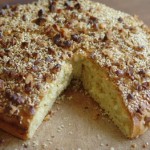 In some places the “VasilOpita” is prepared as a loaf of sweet bread, while in other places it takes the form of a spicy sheet cake (without frosting). But no matter what form a “VasilOpita” may take, they all have one thing in common — each contains a single coin.’ After placing the bread dough or cake batter in the proper baking pan, the baker makes with the foil wrapped coin the sign of the Cross over it, closes his/her eyes, and then secretly places it into the unbaked “VasilOpita.”
While any coin is appropriate, special gold electroplated “Vasilopita Coins” (with an image of St. Basil) are often commercially available (try here).
After the “Vasil()pita” is baked and cooled, it is blessed and cut following Divine Liturgy on January 1. At churches it is blessed and cut in the parish fellowship hall by the bishop or priest, and in homes it is blessed and cut by the head of the household. The blessing of the “VasilOpita” usually begins with the Apolytikion of St Basil the Great (chanted in tone 1 or said):
“Thy sound hath gone forth into all the earth that received thy word. Thereby thou hast divinely taught the Faith; Thou hast made manifest the nature of things that be; Thou hast adorned the ways of man. 0 namesake of the royal priesthood,2 our righteous Father Basil, Intercede with Christ God that our souls be saved.”
Then the following prayer may be said:
O Creator of all things, Lord and King of the ages, plenteous in mercy and bountiful in goodness, who didst accept the Magi’s gifts in Bethlehem, who art the Bread of life that came down from heaven, who by Thine authority didst establish the seasons and the years and dost hold our life in Thy hands: Hear us who pray to Thee on this holy day upon our entrance into the new year of Thy goodness and bless this Vasilopita, which has been offered to Thy glory and in honor of our Father among the Saints Basil the Great, Archbishop of Caesarea in Cappadocia. Do Thou who art Benevolent, look down from Thy holy heaven and send down upon us, upon those who have offered these gifts and upon them that partake thereof, Thine heavenly gifts, for our hope is in Thee, the living God, unto the ages. Bless this parish (home, school, foundation, etc) and our goings out and comings in; replenish our life with all good things and direct our footsteps that we may keep Thy divine commandments, for man shall not live by bread alone. Through the intercessions of Thy Most pure Mother, of our Father among the saints Basil the Great and of all Thy saints who from all ages have been well pleasing to Thee. Amen.
The head of the household then makes the sign of the Cross over the “VasilOpita” with a knife while saying, “In the Name of the Father and of the Son and of the Holy Spirit.” All respond “Amen.” Then pieces of the “VasilOpita” are cut in the following order:
The 1st small piece, cut from the very center of the “VasilOpita,” is for Christ.
The 2nd small piece is for the Theotokos.
The 3rd small piece is for St Basil.
The 4th larger piece is for the poor.
Then large pieces are given to all present, beginning with the eldest and ending with youngest. He or she who receives the “VasilOpita Coin” is traditionally considered to be especially blessed for the New Year (perhaps with a special calling to give alms to the poor?).
Recipe (one among many possible)
Ingredients:
- 2 cups (1 lb.) unsalted butter
- 1 cup vegetable oil
- 5 cups sugar
- 12 eggs, separated
- 4 tsp. vanilla extract
- 1/2 cup sugar, on the side
- 6 cups flour
- 4 tsp. baking powder
- 4 tsp. baking soda
- 2 tsp. salt
- 1 1/2 cups plain yogurt
- 2 cups crushed, toasted almonds
Directions:
- Cream butter, oil, and 5 cups sugar sugar for 10 minutes. Add yolks and flavorings, beat until fluffy.
- Alternate adding all dry ingredients (except salt) and yogurt.
- In separate bowl, beat whites and salt until foamy. Add 1/2 cup sugar. Beat until stiff meringue forms. Fold into 1st mixture so it stays fluffy.
- Pour into greased pan 16 x 11 pan or 14″ round. Add sliced almonds on top. Bake @ 325 degrees for 15 minutes, then add coin. Continue baking for additional 30 minutes.
This article adapted mostly from here, with recipe from here.
Image source.


Stay Connected